




Payroll gross-up seems simple on paper: calculating the gross payment required so that an employee receives a specific net amount after all deductions.
In practice, it’s a complex balancing act involving tax technicalities, payroll knowledge, mathematical logic, and a clear global mobility policy.
Here are five common pitfalls that can lead to inaccurate withholding, compliance risks, or a negative employee experience.
1 Underestimating Multi-Tiered Income Tax Systems
Many countries, including the U.S., operate multi-layered tax systems involving federal, state, and local levels. Applying tax gross-ups across multiple jurisdictions is far more complex than just adding tax rates together. Each tier has distinct rules and reporting requirements:
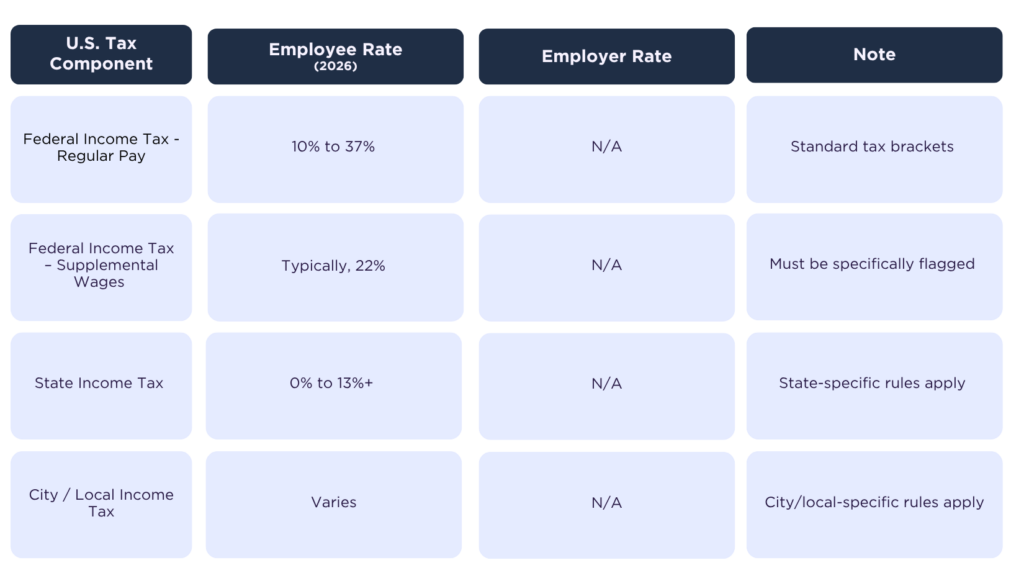
The Pitfall: Applying gross-up only at the national level can significantly understate tax liability, exposing your organization to serious non-compliance risk.
2 Misunderstanding Social Security Rules
Social security can be mistakenly treated as an extension of income tax or assumed to apply only in the employee’s home country. In reality, separate bilateral treaties, legal frameworks, and coverage rules apply. The applicable treatment may depend on the employee’s personal situation, assignment details, and coverage position.
In the U.S., for example, payroll must withhold multiple distinct social security components in addition to the income taxes:
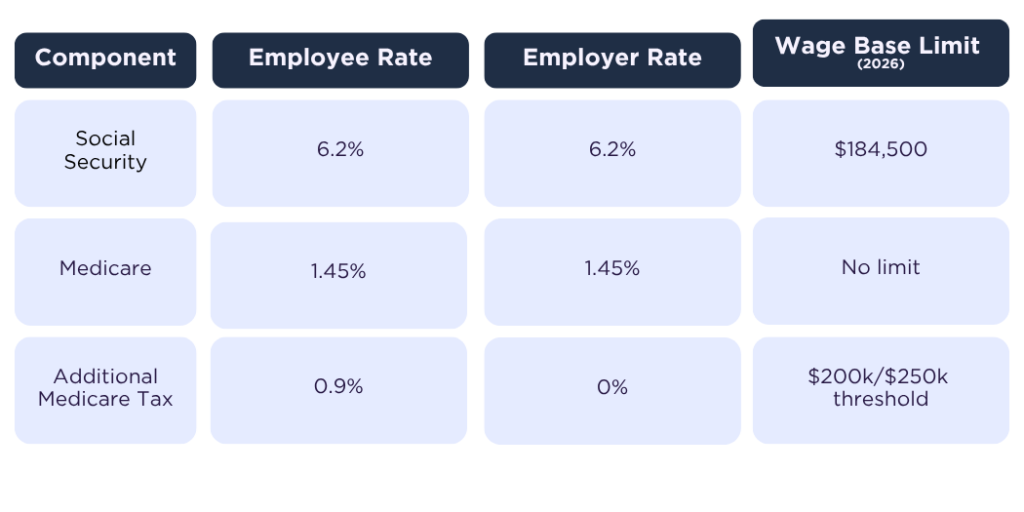
The Pitfall: Because grossed-up social security is a taxable benefit, miscalculating it can distort income tax withholding. Income tax and social security must be assessed and configured independently in payroll calculations.
3 Assuming Payroll Withholding Mirrors Tax Law
While tax law sets overarching principles, local payroll systems often rely on administrative mechanisms to simplify the process.
- U.K. PAYE: Relies on the PAYE tax code to calculate withholding each pay period
- German Lohnsteuer (wage tax): Uses six distinct Tax Classes to determine allowances and monthly withholding
The Pitfall: Modeling gross-ups purely on statutory tax legislation often fails to align with actual local payroll withholding requirements.
4 Overlooking Calculation Methodologies
Payroll withholding methodologies vary widely worldwide. Even where tax systems appear similar, calculation methods can materially alter the outcome.
- Annualized Calculations: Project annual income by incorporating both year-to-date and current-period earnings to create more stable withholding for regular pay, and generally apply special handling for non-regular payments such as bonuses or relocation benefits.
- Cumulative Tax Methods (such as U.K. PAYE): Track year-to-date earnings and tax every pay period, self-correcting automatically throughout the tax year.
- Monthly Calculations: Treat each pay period in isolation. Tax is calculated solely on the current period’s earnings utilizing prorated withholding tables and allowances. While simple to administer, this approach distorts withholding when income fluctuates.
The Pitfall: Applying the wrong calculation methodology for a tax authority can lead to incorrect tax withholding, artificial tax spikes, and costly payroll adjustments.
5 Overlooking Company Policy Nuances
Mobility policies drive how a gross-up should be applied. While more traditional full tax equalization may provide broader coverage, such programs are not always suitable for today’s diverse global workforce. Modern policies like “Local Plus” protect only selected allowances, introducing further complexity.
When grossing up specific allowances rather than full compensation, company policy determines how tax brackets apply:
- Top-Slicing: Employer pays tax at the employee’s highest marginal tax band.
- Bottom-Slicing: Employer pays tax at the lowest tax band.
When policy only protects selected compensation items, questions such as which tax bands apply become critical.
The Pitfall: These decisions are driven by corporate policy, not law. Misaligning payroll logic with mobility policy leads to over- or under-paying tax costs.
Best Practices for Global Mobility Leaders

- Prioritize Data Quality: Maintain accurate compensation data, taxability mapping, and employee payroll attributes to drive successful payroll gross-up.
- Separate Income Taxes and Social Security: Assess each of these components independently, as they are governed by different rules.
- Align Payroll with Mobility Policy: Ensure the gross-up actually reflects the company’s intention and policy coverage.
- Understand Local Payroll Rules: Design formulas for payroll processing execution, not just statutory tax returns.
- Leverage technology: Automate repetitive calculations and control points to reduce manual errors and enhance auditability.
Gross-up calculations are often seen as a mathematical challenge. In reality, they’re a process challenge. Companies that consistently get it right combine clear policy with strong data governance, effective payroll controls, and fit-for-purpose technology. Establishing these fundamentals ensures smooth, accurate payroll delivery and helps prevent costly year-end reconciliations.
Take Control with Equus
Equus’s enhanced global compensation management and payroll gross-up solution will:
- Reduce Manual Effort – Automate complex gross-up calculations, payroll instructions, reconciliations, and reporting to improve accuracy and efficiency.
- Manage Compensation Accumulation – Collect, store, and update your global mobile population’s pay, benefits, and expenses all in one single platform.
- Improve Compliance – Support country-specific payroll, tax, and social security gross up requirements while maintaining a complete audit trail.
- Provide End-to-End Visibility – Connect mobility, payroll, tax, and compensation data in a single workflow and reporting environment.
Find out how Equus can help solve your organization’s payroll challenges. Contact us today.